
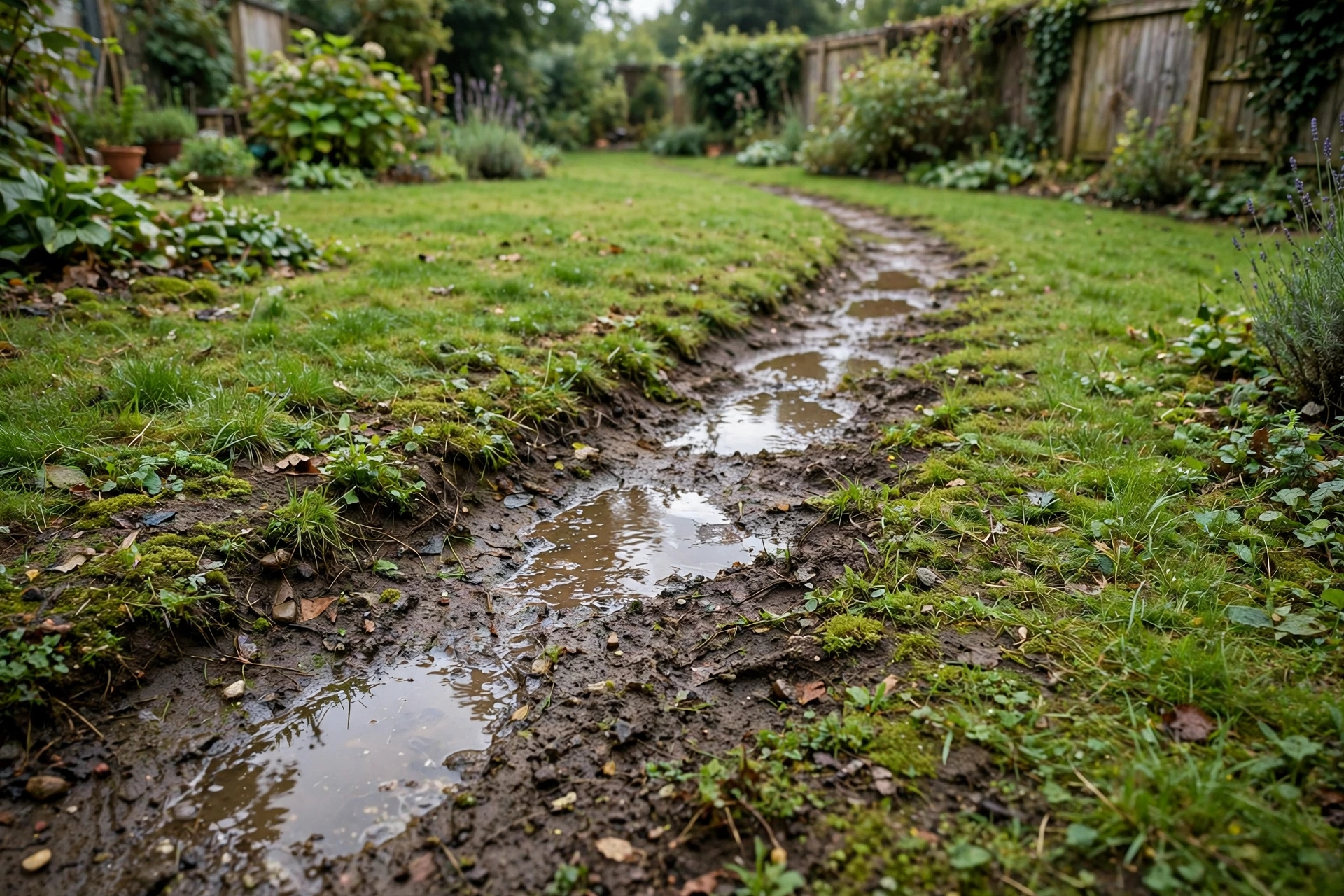
A path that crosses your backyard should be easy to walk on in all weather. Instead, many paths turn into a muddy backyard path after rain. Shoes get dirty, grass gets worn away, and the route becomes slippery. In addition, the mud spreads into the house and onto the patio. A muddy path is not just a mess. It is a sign that water and foot traffic are damaging the ground.
The good news is that a muddy backyard path can be fixed with a clear plan. You do not need to pave the whole yard. In most cases, a firm surface on the walking route, plus better drainage, will solve the problem. This guide explains why a path turns muddy, and it shows a step-by-step fix using stepping stones or gravel.
Why Does a Path Across Your Backyard Turn Muddy?
A path turns muddy when the ground cannot cope with feet and water at the same time. Each cause below makes the problem worse, and most muddy paths have more than one cause.
First, repeated walking compacts the soil. Grass is worn away, and the bare soil is pressed hard. As a result, water cannot soak in, so it sits on the surface. In addition, the compacted ground is smooth and slippery when wet. That is why the most-used route is often the muddiest part of the yard.
Second, water collects on the path. A low spot, a slight dip, or a slope that sends water toward the path will all cause puddles. For example, water from a roof, a patio, or a higher part of the yard can run onto the path. If the water has nowhere to go, the path stays wet for days after rain. If flooding is a wider problem in your yard, read our guide on how to stop your backyard from flooding after heavy rain.
Traffic, Water, and Bare Soil
Third, bare soil has no protection. Grass roots hold soil together and help water soak in. When the grass is gone, rain hits bare soil directly. As a result, the soil turns to mud, and it washes away a little more with each rain. In addition, shade can slow drying, because the sun cannot reach the wet ground. Our guide on how to add shade to a backyard that gets full sun all day can help you plan shade and sun, so the path area dries faster.
Fourth, the soil itself may hold water. Heavy, clay-like soil drains slowly. It stays wet long after rain, and it turns soft under feet. However, even good soil will turn muddy if it is walked on every day with no firm surface. The fix is to give feet a firm surface, and to give water a way to drain away.
How to Fix a Muddy Backyard Path: A Step-by-Step Fix
Work through these steps in order. Start with the route and the water, then build the surface, and then keep it in good shape.
Step 1: Mark the Real Walking Route
First, watch where people actually walk. The worn, muddy line shows the real route. As a result, you should build the path there, not where you think people should walk. Mark the route with string or small sticks. In addition, make the path wide enough for one person to walk with ease, about 60 to 80 centimetres wide. A path that is too narrow will force feet onto the grass at the edges.
Step 2: Improve Drainage Before You Build
Next, fix the water problem. Fill any deep dips with soil, and shape the ground so water runs away from the path, not onto it. For example, a slight slope to one side is enough. In addition, remove leaves and soil that block the edges of the path, so water can drain away. However, do not dig a deep ditch next to the path, because it can become a trip hazard and a muddy spot of its own.
Step 3: Lay Stepping Stones for a Simple Fix
Stepping stones are a good first fix. Choose flat stones that are large enough for a whole foot. Place them along the route, one step apart, so you can walk from stone to stone with ease. Then, dig a shallow hole for each stone, so the top of the stone is level with the ground. As a result, the stones will not wobble, and a mower can pass over them. Fill the gaps with soil or small gravel, and check the stones after rain to see if any have sunk.

Step 4: Build a Gravel Path With Edging
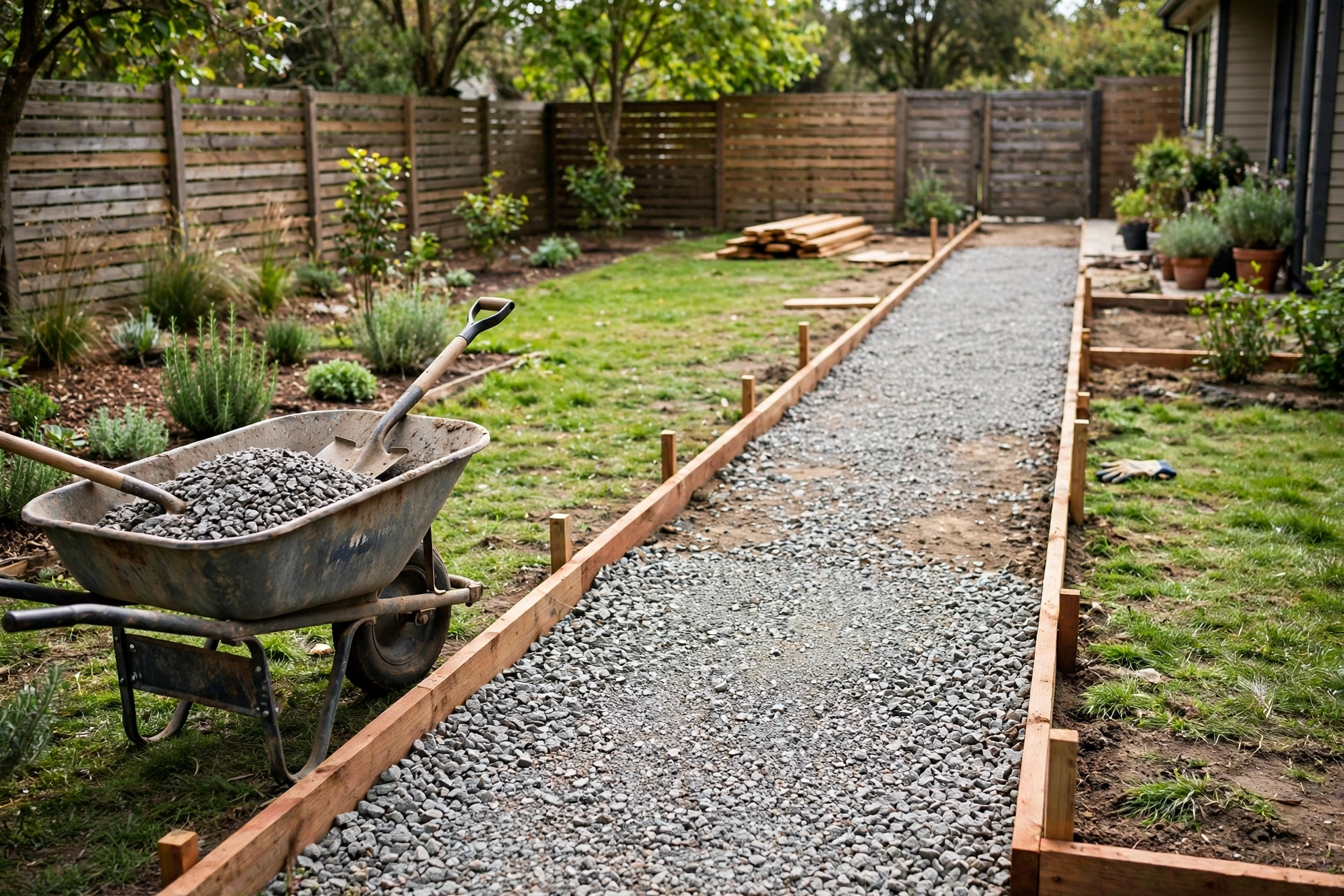
For a path that is used every day, gravel is a stronger fix. First, dig out the route to a depth of about 10 centimetres. Then, add edging along both sides, such as timber or stone, to hold the gravel in place. Next, spread a layer of coarse gravel, and firm it down. Finally, add a layer of finer gravel on top, and firm it again. In addition, a layer of weed fabric under the gravel can stop soil from mixing with the stones. For background on the main types of stone paths, see the general overview of stepping stones and simple stone routes.
Step 5: Keep the Edges Firm and Clear
After the path is built, protect its edges. Grass that grows over the path will trap water, so trim the edges often. In addition, keep the path clear of leaves and soil. A clean edge helps water drain away, and it keeps the path looking tidy. If mud from the path spreads onto your patio, see why your patio is always dirty and the outdoor cleaning mistakes to fix.
Step 6: Maintain the Path Through the Year
Check the path after heavy rain. Top up gravel where it has thinned, and lift and re-level any stone that has sunk. As a result, the path will stay firm and dry. In addition, avoid walking on the same wet grass next to the path, because that will create a new muddy route. If a new worn line appears, widen the path or add a stone there. A small fix each season is much easier than a big rebuild.
Common Mistakes That Keep a Muddy Backyard Path Muddy
Many people try to fix a muddy path, yet the mud comes back. In most cases, one of these mistakes is the reason.
One mistake is laying stones or gravel on top of mud, with no preparation. As a result, the stones sink, and the gravel mixes with the mud. Always dig out the soft top layer first, and build on firm ground. In addition, a thin layer of gravel will not last. Use enough depth, so the surface stays firm under feet.
Another mistake is building the path in the wrong place. If the path does not follow the route people actually use, they will walk around it and wear a new muddy line in the grass. However, when the path follows the worn route, people will use it every time.
A third mistake is forgetting about water. A path built in a low spot will collect water, even if the surface is good. For example, a gravel path in a dip will turn into a puddle after rain. Fix the drainage first, and then build the surface. In addition, check where water runs during heavy rain, and keep that route clear.
A final mistake is using soil to fill gaps between stones. Soil turns to mud when wet, so it defeats the purpose of the stones. Use small gravel or sand instead, because they drain well and stay firm. As a result, the path will stay clean and easy to walk on, even after rain.
Frequently Asked Questions
How do I fix a muddy backyard path without gravel?
Use stepping stones. Lay large, flat stones along the worn route, one step apart, and set them level with the ground. In addition, improve the drainage first, so water does not sit on the path. Stepping stones work well for a path that is used a few times a day, and they keep most of the grass in place.
How deep should a gravel path be?
About 10 centimetres deep is a good guide. Dig out the route, add edging, and fill with a coarse layer first, then a finer layer on top. As a result, the path will stay firm and will not sink into the mud. However, if the ground is very soft, you may need a deeper base and a layer of firm material under the gravel.
Can I lay a path on wet ground?
It is best to wait for a dry spell. Wet soil is soft, and stones will sink as you work. In addition, it is hard to level a path on mud. If you must work in wet weather, dig out the mud first, and build on the firm soil below. Then, let the path settle for a few days before you use it a lot.
Will grass grow back on a muddy path?
Grass can grow back if the traffic stops, but it will wear away again as soon as people walk on it. As a result, grass alone is not a fix for a high-traffic route. However, you can keep grass on the edges of a stone or gravel path, and it will help the path look natural and tidy.
How do I stop a gravel path from spreading?
Use edging on both sides. Timber, stone, or metal edging will hold the gravel in place. In addition, keep the gravel level a little below the top of the edging, so it does not spill over. Rake the gravel back into place after heavy rain, and top it up when it thins out.
Save This Guide for Later
Keep this guide for your next dry spell. Mark the real route, fix the drainage, and build a firm surface with stones or gravel. A muddy backyard path can become a clean, dry route that you can use in all weather.
